
|
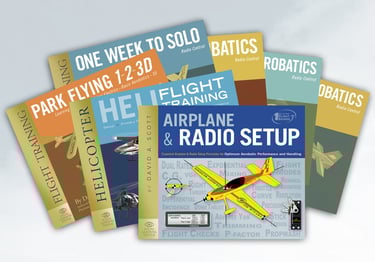
Testimonial 8/2/05 RE: RCM Magazine Article: Aerobatic Flight School Review Dear Editor, My first trainer was a Midwest Aerostar 14 years ago. It took me most of the summer to build it to the satisfaction of the club flight instructor. I spent most of the next summer waiting for my turn to fly with the club's flight instructor who was busy with too many students. I did learn to fly simple circles and land. Within two weeks of soloing my pride and joy airplane was in pieces and I was discouraged to say the least. When I relocated I packed up my airplane supplies and did not unpack them for several years. In the spring of 2003 I came across some information on the 1st U.S. RC Flight School. The information about their aerobatic school intrigued me. I checked out the website and found out that they were booked for the entire summer. I was disappointed but I did purchase the Sport (Basic) Aerobatic Manual by David A. Scott. My flying buddies laughed when I brought up the flight school, "For $600 you could buy another whole plane. Why would you spend that money on a week of flying when you can fly here for free?" I was told. After their lack of enthusiasm when I first broached the topic I decided to see if they could notice an improvement in my flying skills after I attended the flight school. Flight School: I met David Scott who owns and runs the 1stUSRCFS as well as my fellow student. The Aerobatic Flight School has only two students for 4 days. (The Beginner classes have three students for 5 days.) After introductions, the first hour or so was spent discussing our current abilities and goals for the week as well as future flying goals. My goal was to advance beyond the simple loop and roll, as most of my attempts at anything further resulted in an incomplete maneuver and a period of level flight to restore my heart rate. I also admitted to Dave that I did not understand how to use the rudder while in flight. Dave believes there are two basic types of flyers. Most club flyers are "Reactors" who watch what the airplane is doing and react to correct the deviation while in flight. They wait to see a deviation before it occurs to them that a correction is needed. By definition, they are slightly behind the airplane. For a "Reactor", improvement takes lots of practice and fuel for incremental improvements. I had been flying like this. On the other hand, "Controllers" anticipate the appropriate corrections to prevent the deviation before it occurs. They are thinking ahead of the airplane. An important part of being a "Controller" is identifying which corrections need to be made ahead of time. This is the heart of the DAS (David A. Scott) system in his manuals, and used at the flight school. This all sound's great, but what does it mean in plain English? After a week the best example I can think of is driving a car with the steering badly out of alignment. A "Reactor" will move the steering wheel constantly to correct the pull to the right, whereas the "Controller" will be aware that the car pulls to the right and will hold in the correct amount of left to keep the car traveling straight. The basic aerobatic trainer is a Super Stick with a .65 engine which we flew from a target on the right side of the field to a target on the left side of the field. Initially it was an adjustment for me flying the way Dave wanted me to fly. My turns had consisted of moving the right stick 45 degrees and correcting, as needed (Reactor). Dave had me use only aileron to bank the plane, neutralize the stick, and hold only steady up elevator to complete the turn, neutralize the stick again, and then opposing aileron to level the plane. After each turn-around I evaluated each turn, with Dave's directions, and decided whether to use more or less control input, aileron or elevator, the next time (Controller). I would complete the turn-around imperfectly, but I would have learned which control input to change for the next time. In just a few attempts my turns improved rapidly and became much smoother. On my first flight we moved on to loops and barrel rolls as well. It was impressive to also watch my fellow student fly and then see the corrections, as Dave would occasionally take control and demonstrate the maneuver. On his next attempt my fellow student's maneuver would be much closer to Dave's example. Then we sat at the table and "reflected" on our flight. Discussion and analysis is a very important part of the DAS system. After each flight Dave would make notes on what we did well and things to improve on as well as our goals for our next flight. We spent as much analyzing our flights as we did flying it. Dave often referred back to one of his manuals to stress a point and give me reminders to take back home along with his notes on our flying. Questions were encouraged and answers explained thoroughly as we discussed airplanes, engines, radios, fuel, and many other RC related topics. Dave had to remind me to enter my maneuvers from straight (to the flight line) and level flight, but in a short time my loops became round instead of egg-shaped. We were flying in a 15 to 20 mph crosswind to our pattern. Back home I usually did not fly in such windy conditions but at the flight school I was learning to adapt. I learned how to use my rudder input to correct for the wind and exit a loop on the same pathway as I entered the loop. Prior to this the only time I used the rudder was ground taxing or to spin from a great height and then recover the plane. Subtly using rudder correction to smooth out my flight was a novel experience for me. I flew five flights the first day. I was flying round loops, level rolls, Cuban turnarounds, and reverse Cuban turnarounds while using my rudder to correct for a cross wind on my maneuvers. On day two we continued to refine the prior lessons and added multiple level rolls and 4-point rolls. I was getting excited, as I had never been capable of these stunts before. Dave explained his dislike of the exponential option when flying precision scale aerobatics. Exponential control gives the plane a mushy or non-responsive feel around neutral causing large over corrections (Reactor type flying). Linear (non-expo) stick travel gives the flyer better feedback and smoother flight. If the plane is too sensitive for a pilot then the travel throw should be reduced to allow smooth flight. As the pilot becomes accustomed to the sensitivity the travel can be gradually increased. Dave feels that the exponential option on radios has decreased the skill of the average club flyer. Dave has many opinions but after listening to him and seeing the results on my flying, it is hard to disagree with him. My Plane: So far all of my flying was done on the 1stUSRCFS airplane. At the end of the second day Dave ground checked my own airplane. I had brought a new plane I thought would allow me to continue my aerobatics back home. Dave has the largest flight box I have ever seen and it came in handy as he had supplies with him to fine-tune my Kaos ARF. On the third day I flew maneuvers with my own plane. My Kaos was slightly more sensitive than the Super Stick I was flying so we decreased the control throws slightly to allow me to fly as smoothly as I had been. In time I can increase the throws when I am ready. The important thing is to fly smoothly in my maneuvers, not constantly correcting my over controlling my plane. Now I was really getting excited. I felt much better at flying my own plane. I knew it would be different to fly without Dave's advice back home but I now knew that I could fly the maneuvers with my own plane. Day 4 was what Dave called the fun day. After learning so much he was careful not to overload me with more new stuff. We practiced combinations of our earlier maneuvers and even added Hammerhead stall and knife-edge flight for me to refine back home, considering my flight skills at the beginning of the week, successful knife-edge flight was incredible to me. Dave advised me to take a couple days off from flying to relax and reflect on my lessons. I was advised to start my maneuvers without all of the rudder refinements initially and add the refinements in the "crawl-walk-run" technique we used at the flight school. Back Home: My first time back at the club field I was nervous without Dave standing next to me giving me feedback. I started slowly trying the things I had learned at the flight school. After my first flight a buddy commented that I was having a good day. On my second flight I used rudder corrections on my maneuvers and successfully did a couple of 4-point rolls. After landing my regular flying buddies wanted to know what happened. I had not capable of flying like this two weeks earlier. I explained about the flight school. My last flight finished with a knife-edge pass across the field and cheers upon landing. Now when flyers hear that I have been to aerobatic flight school they always ask if it helped or if it was worthwhile. I cannot be more positive about my experience to other flyers. There was no other way for me advance my skills so quickly. I am not sure any amount of time would have helped this much. I think differently about flying. As the flight school taught me, I no longer react to what the aircraft is doing. I anticipate what to do and control the plane. The smoothness of my flights is better. Probably the best endorsement of 1stUSRCFS is that I was only home a couple of weeks before I reserved a spot for the next year to further advance my flight skills. David Scott tells me many of the aerobatic students are repeat customers and I cannot think of a better endorsement of his flying school than that. NOTE: This article was written after I attended 1stUSRCFS in 2003. I have since returned in July of 2004. Dave helped me learn combinations of maneuvers and I am now able to do a slow roll down the length of the field, a maneuver I once thought only experts could do. With a class size of only two students in the aerobatic flight school it is easy to make friends. The student from this year and I were at about the same skill level and we both plan to come back the same week next year to see how much we have each improved. Dave tells us this happens regularly. Since I am planning to return again I must think the flight school is worthwhile. My flying is improving and I am having more fun flying aerobatics than ever. For those flyers that are interested in Dave Scott's flying method and are not able to attend his flight school, he has 4 flight training manuals. There is Primary (Solo) Flight Training, Sport (Basic) Aerobatics, Intermediate (Precision) Aerobatics, and Advanced Aerobatic Flight Training. All of the books build on each other and explain how to crawl-walk-run as taught at the flight school. Ken Weddell
|
|
| (c)2006 1st U.S. R/C Flight School - Home - Site Map - About Us - Contact | ||